Why Speed-to-Lead Automation Is the #1 Growth Lever for Small Businesses in 2026
Why Speed-to-Lead Automation Is the #1 Growth Lever for Small Businesses in 2026
Here's a number that should make every small business owner stop and pay attention: 78% of customers hire the company that responds first. Not the cheapest. Not the one with the most reviews. The one that responds first.
In 2026, that window is measured in minutes — sometimes seconds. If your follow-up process still depends on someone manually checking a form submission, returning a missed call tomorrow morning, or routing a lead through a group text chain, you are losing business to competitors who have already automated that exact moment.
This post breaks down what speed-to-lead automation really means, why it matters more than ever, and how small businesses are using it to grow their pipelines without adding headcount.
What Is Speed-to-Lead Automation?
Speed-to-lead refers to how quickly your business responds to a new inbound lead — from the moment they fill out a form, click a chat button, call your number, or send a message. Speed-to-lead automation means that response happens instantly and without a human having to initiate it.
Instead of a prospect waiting for a callback, they receive a personalized text message or email within seconds of opting in. Instead of a missed call disappearing into a voicemail nobody checks, an automated text fires back immediately to keep the conversation alive.
The goal is simple: engage every lead at their highest point of interest — right now — before they've had a chance to call your competitor.
The Numbers Don't Lie: Why Response Time Is Everything
The data behind speed-to-lead is striking, and it has only grown stronger heading into 2026:
- 78% of customers hire whoever responds first when comparison-shopping between service providers.
- Businesses that respond within 2 minutes convert 62% of inbound leads — a dramatic drop-off occurs for every minute of delay after that.
- Automated emails generate 320% more revenue than non-automated email campaigns, according to widely cited marketing research.
- 74% of small business owners are already using or testing AI tools in 2026, according to Bluevine's 2026 Small Business AI Trends Report — meaning your competitors are catching on fast.
- 48% of SMBs using AI save at least four hours per week, freeing up owners and teams to focus on high-value work.
The takeaway is clear: the businesses gaining ground are not necessarily the ones with bigger ad budgets or larger teams. They are the ones responding faster, following up consistently, and keeping their pipeline working 24 hours a day.
Where Most Small Businesses Are Losing Leads Right Now
Before building a solution, it helps to understand where the leaks are. Here are the most common speed-to-lead failure points for small businesses in 2026:
1. The Missed Call With No Follow-Up
A missed call at 4:47 p.m. can cost a small business real revenue. Without an automatic text-back system, that caller moves on — often within the hour. They don't leave a voicemail, and they don't wait for you to return their call the next morning. They simply call the next business on the list.
2. The Lead Form That Sits Until Morning
Web forms and contact pages generate intent at all hours. If your system doesn't instantly acknowledge that submission with a personalized message, the lead cools fast. By the time someone manually follows up the next business day, the prospect has often already made a decision.
3. Fragmented Communication Channels
Many small businesses still have their leads scattered across desk phones, mobile phones, contact forms, and individual email accounts. That fragmentation creates gaps — calls are missed, text threads stay on employee devices, and lead history disappears when someone leaves the team. No one owns the follow-up, so no one does it.
4. Inconsistent Manual Follow-Up
When follow-up depends entirely on a person remembering to do it, it will always be inconsistent. Some leads get three calls in a week. Others are never contacted again after the first attempt. Neither extreme serves the business well.
How Speed-to-Lead Automation Works in Practice
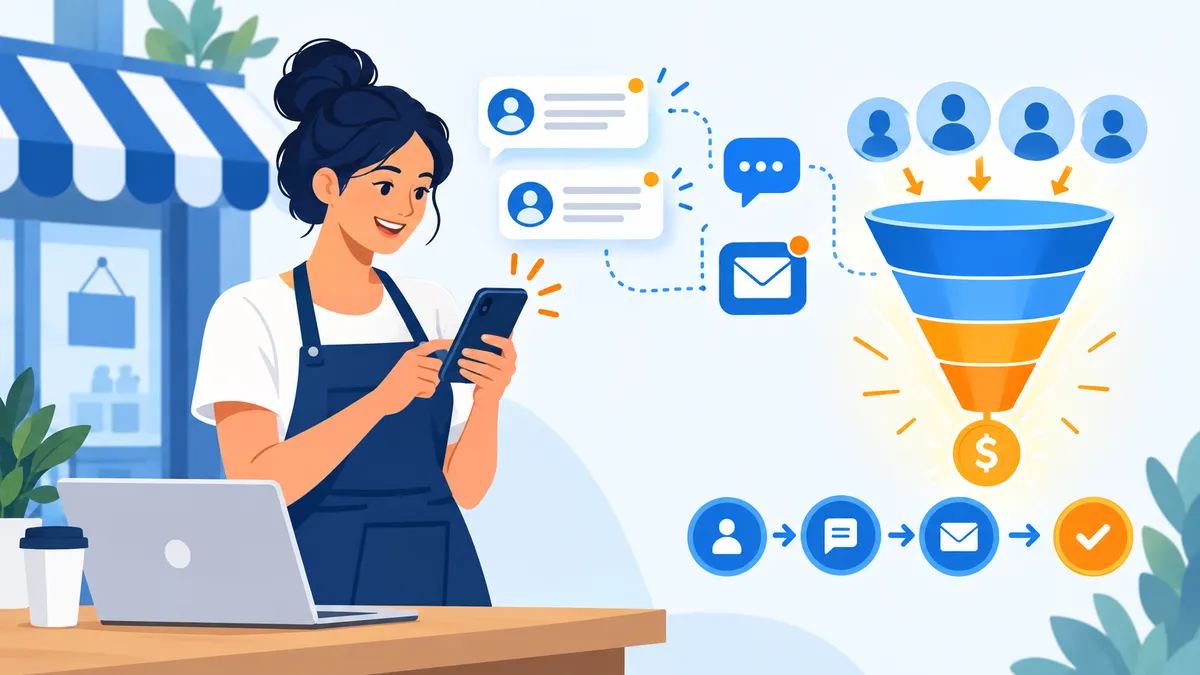
A well-built speed-to-lead system doesn't just fire off one message and call it done. Here's what a complete automated lead response engine looks like:
Step 1: Instant First Contact
The second a prospect opts in — via a form, a missed call, a chat message, or an ad click — they receive an automated, personalized text and email. This happens in real time, beating competitors to the punch before the prospect has even closed their browser tab.
Step 2: SMS and Email Drip Campaigns
Not every lead is ready to buy immediately. An automated drip sequence keeps your business top-of-mind over the following days and weeks. SMS messages carry an open rate close to 98%, making them far more effective than email alone. Combining both channels — texts for immediacy and emails for education — creates a powerful nurture engine.
Step 3: Smart Reply Routing
When a prospect replies to one of your automated messages, the automation pauses and instantly alerts your team that a real conversation is ready to be had. This is the critical handoff point — the automation warms the lead, and your team closes the deal. No lead gets lost, and no conversation gets hijacked by a bot when a human touch is needed.
Step 4: Missed Call Text-Back
Every missed call triggers an immediate outbound text. Instead of losing the prospect to voicemail, you start an SMS conversation automatically — giving your team a warm, active lead to follow up with rather than a cold callback list.
Step 5: Centralized Inbox
All conversations — SMS, email, social DMs, web chat — flow into one unified inbox. Your team sees full lead history, context, and communication threads in one place, eliminating the scattered channels that cause leads to slip through the cracks.
The Role of AI in Modern Lead Follow-Up
In 2026, speed-to-lead automation has leveled up significantly with AI. Beyond simple rule-based triggers, AI-powered systems can now:
- Qualify leads in real time through conversational AI that asks the right questions and scores the lead based on responses.
- Book appointments automatically — handling inbound inquiries, checking calendar availability, and confirming bookings without any human involvement.
- Reply to incoming messages 24/7 with contextually appropriate, brand-consistent responses.
- Auto-reply to positive reviews with personalized, SEO-friendly responses that strengthen local search rankings.
- Handle after-hours inquiries so that a prospect reaching out at 10 p.m. gets a helpful, immediate response rather than silence.
The strongest model in 2026 combines rule-based automation as the backbone — for consistent, predictable triggers — with AI layered on top for tasks that require language, nuance, and context.
Speed-to-Lead Is Not Just for Large Businesses
One of the most persistent myths is that automation is only for enterprise companies with dedicated tech teams and large budgets. That's simply no longer true.
Today's all-in-one marketing and CRM platforms make it possible for a solo operator or small team to deploy a complete speed-to-lead system — including instant SMS follow-up, automated drip campaigns, AI chat, missed call text-back, and a unified inbox — under a single monthly subscription.
The investment is modest. The ROI is measurable. And the alternative — continuing to lose leads to faster-responding competitors — is far more costly in the long run.
According to recent research, when small businesses implement automation thoughtfully, the returns tend to show up within the first several months, not years.
What a Done-For-You Speed-to-Lead System Looks Like
For most small business owners, the biggest barrier to automation isn't cost — it's time and complexity. Setting up triggers, writing sequences, connecting CRM tools, and testing workflows takes real expertise. That's why a done-for-you approach is so valuable.
At Bridge City Marketing, we build complete, activated speed-to-lead systems for small businesses — fully set up, tested, and ready to run from day one. Our clients don't have to struggle with multiple platforms, integrations, or marketing tools. They get one turnkey system designed to:
- Engage every new lead instantly with a personalized text and email
- Nurture leads through automated SMS and email drip campaigns
- Route live replies directly to your team for human follow-up
- Recover missed calls with automatic text-back sequences
- Centralize all communication in one universal inbox
- Book appointments automatically, 24/7, using AI voice and chat
- Request and manage 5-star reviews on autopilot
The result is a pipeline that works around the clock — turning cold leads into paying clients without requiring you to manually manage every step of the process.
Frequently Asked Questions
How fast should I respond to a new lead?
Ideally, within 2 minutes or less. Research consistently shows conversion rates drop significantly with each passing minute. Automation makes sub-minute response times achievable without any manual work.
Does automated follow-up feel impersonal to prospects?
Not when it's built correctly. A well-crafted automated message is personalized with the prospect's name, references their specific inquiry, and reads naturally. Most prospects simply experience it as a fast, helpful response — which is exactly what they wanted.
What happens when a lead replies to an automated message?
Smart reply routing pauses the automation and alerts your team immediately, so a real person can step in and continue the conversation. This keeps automation where it belongs — warming and qualifying leads — while your team focuses on closing.
Do I need to hire a tech team to set this up?
No. A done-for-you marketing partner like Bridge City Marketing handles the entire setup, from CRM configuration to automation workflows, message sequences, and AI integration. You get a complete system without the learning curve.
Is speed-to-lead automation only relevant for service businesses?
It's especially high-impact for service-based businesses — contractors, med spas, real estate agents, consultants, and local professionals — but the core principle applies to virtually any business that handles inbound leads.
The Bottom Line: Your Fastest Response Wins
In a market where 78 out of 100 customers hire whoever responds first, every unanswered call, every delayed form reply, and every manual follow-up that gets forgotten is a paying customer walking out the door.
Speed-to-lead automation doesn't replace the human relationships that grow great businesses. It protects those relationships by making sure every prospect gets a fast, professional, consistent first response — and stays engaged until they're ready to buy.
The businesses winning in 2026 are the ones that removed the repetitive work from their teams and used automation to hold the door open for every lead that knocks.
Ready to build a speed-to-lead system that works while you sleep? Bridge City Marketing specializes in done-for-you CRM automation, AI follow-up, and lead nurture systems built specifically for small businesses. Book a free demo today and see exactly how fast your new pipeline can run.
📞 Call us at 864-777-8144 or visit bridgecitymarketing.agency to get started.
