Speed to Lead: Why the First 5 Minutes Determine Whether You Win or Lose the Sale
Speed to Lead: Why the First 5 Minutes Determine Whether You Win or Lose the Sale
Here's a number that should stop every small business owner in their tracks: the average business takes 47 hours to respond to a new lead. Meanwhile, the research is clear — businesses that respond within 5 minutes are up to 21 times more likely to qualify that lead than those who wait 30 minutes.
That gap — between what the data says and what most businesses actually do — is where deals silently die every single day.
If you've ever invested in ads, built a website, or worked hard to earn a phone call or form submission, this article is for you. Because the problem usually isn't your marketing. It's what happens (or doesn't happen) in the minutes after a lead comes in.
The 5-Minute Rule: What the Data Actually Says
The research on lead response time is overwhelming — and consistent. Here's what the numbers look like in 2026:
- 78% of buyers choose the first business to respond — not the cheapest, not the highest-rated. The first.
- Businesses responding within 5 minutes are 100x more likely to make contact than those who wait 30 minutes.
- After the 5-minute window closes, conversion odds drop by 10x within the first hour alone.
- Companies that respond within an hour are 7x more likely to qualify a lead than those who wait even 60 minutes — and 60x more likely than those who wait 24 hours or more.
- Leads contacted in under 5 minutes achieve a 32% close rate — compared to just 12% for leads contacted after 24+ hours.
And here's the alarming reality: despite all this data, only 23% of businesses respond within 5 minutes, while 42% take longer than 24 hours. Some never respond at all.
Why Does It Happen So Fast?
When a prospect searches for your service, they're typically contacting two or three businesses simultaneously. Their urgency is highest at the exact moment they reach out — and it decays almost immediately. Every minute you wait, they're cooling off, second-guessing, or booking with whoever responded first. A customer's buying window is not measured in hours. It's measured in minutes.
The Real Cost of a Slow Response
Slow response times don't just cost you one sale. They create a compounding revenue problem that grows over time.
Think about the lifetime value of a single customer:
- A new HVAC customer can be worth $8,000 over five years when you factor in maintenance plans and referrals.
- A loyal dental patient might represent $3,000 annually for a decade.
- For a service business generating $500K annually, a 10% lead leakage rate from slow responses translates to $50,000 left on the table — every year.
When you lose a lead because you took 12 hours to call back, you're not losing a single transaction. You're losing a relationship worth thousands — plus the referrals they would have sent your way.
The math is brutal. And for small businesses competing against larger, better-staffed operations, speed is the single most controllable factor in whether your marketing investment actually produces revenue.
Why Most Small Businesses Struggle With Speed
This isn't about negligence — it's a structural problem. Unlike enterprise companies with dedicated sales development teams, most small businesses rely on a handful of people to handle everything: service delivery, bookkeeping, customer calls, and answering new inquiries. That's exactly why response times drag.
Leads arrive through web forms, chat widgets, social media DMs, missed phone calls, and email — at all hours of the day. A human-routed, business-hours-only workflow simply cannot cover that surface area fast enough. Over 40% of high-intent inquiries arrive during evenings and weekends. A business that goes dark from Friday evening to Monday morning has a 61-hour window during which motivated prospects hit voicemail and book with a competitor instead.
The problem isn't awareness — it's capability. Surveys show that 35% of business leaders say a five-minute response is essential, yet a significant portion of that same group fails to meet their own standard. The volume and variety of inbound channels have simply outgrown the manual processes most teams rely on.
The Solution: Automated Lead Follow-Up That Works 24/7
Here's the good news: you don't need to hire more staff to solve this. You need the right system — one that responds instantly on your behalf, around the clock, across every channel.
Modern marketing automation platforms make it possible for even a two-person operation to respond to every lead in seconds. Here's what a best-in-class automated lead follow-up system looks like:
1. Instant Speed-to-Lead Response
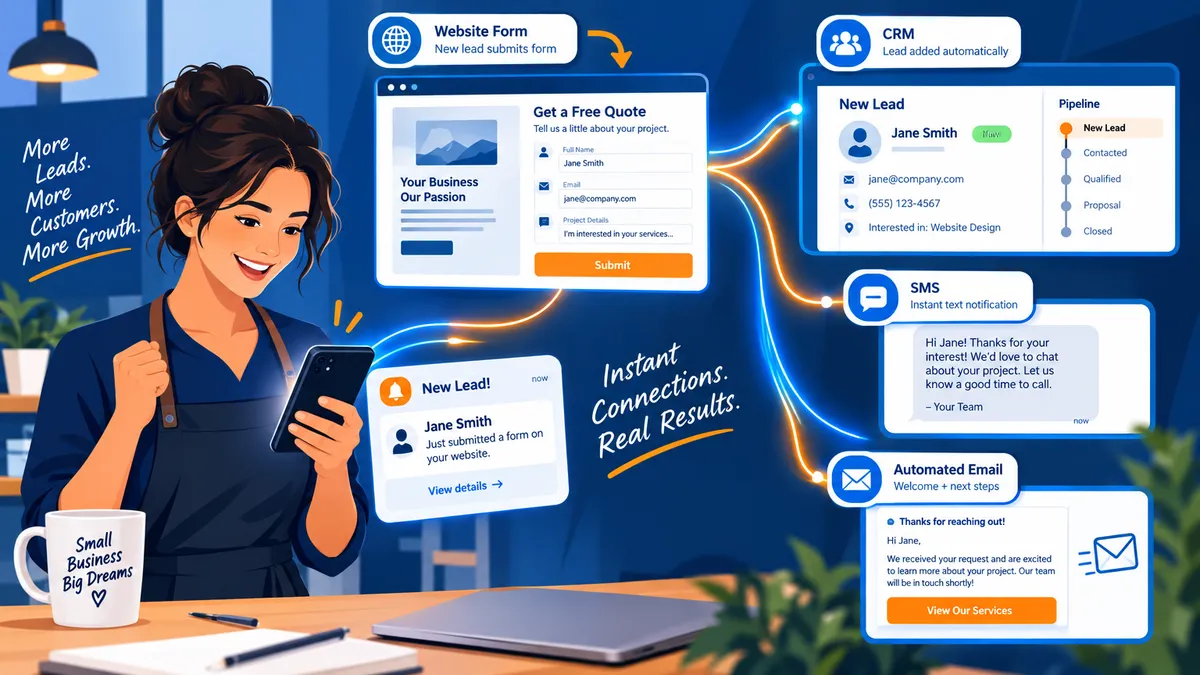
The moment a prospect fills out a form, clicks your chat widget, or calls and is missed, they receive an automated, personalized text and email within seconds — not hours. This immediate acknowledgment keeps them engaged and signals professionalism before they even think about calling a competitor.
2. Missed Call Text Back
One of the most common small business pain points: a call comes in while you're on the job, it goes to voicemail, and the customer books with whoever answered. A missed call text-back system automatically sends an SMS to anyone who calls and doesn't reach you, opening a real text conversation before they move on.
3. SMS & Email Drip Campaigns
Not every lead is ready to buy today — but that doesn't mean they're lost. A well-built automated nurture sequence keeps your business top-of-mind by combining the 98% open rate of SMS with the educational depth of email. Over days and weeks, these touchpoints build trust and bring warm prospects back when they're ready to commit.
4. Smart Reply Routing
The moment a prospect replies to your automated message, the system instantly pauses the automation and alerts your team to step in. You get the best of both worlds: machine-speed first contact plus a human touch when it matters most.
5. AI Voice & Chat Coverage
AI-powered voice and chat tools handle inbound inquiries, qualify leads, and book appointments on your behalf — 24 hours a day, 7 days a week. While you sleep, your business is still answering questions and filling your calendar.
6. Easy Booking & Calendar Integration
The fastest path from lead to closed deal is letting prospects schedule themselves. Embedding instant booking into your follow-up sequence removes friction and dramatically increases the percentage of leads that turn into actual appointments.
What This Looks Like in Practice
Imagine a homeowner searches for a local plumber on a Saturday evening and fills out your contact form. Here's what happens with an automated system in place:
- Within 30 seconds: They receive a personalized text — "Hi [Name], thanks for reaching out! We'd love to help. Here's a link to book a free estimate at a time that works for you."
- Within 5 minutes: A follow-up email arrives with your company info, a review snippet, and a clear next step.
- When they reply: Your team is instantly notified and a real conversation begins.
- If they don't respond: A follow-up SMS goes out 24 hours later, and another at 48 hours — keeping you in front of them without any manual effort.
Compare that to the business that gets the same lead, sees it Monday morning, and calls back two days later. That homeowner already has running water — courtesy of your competitor.
FAQ: Speed to Lead & Automated Follow-Up
How fast should I respond to a new lead?
The target is under 5 minutes for any high-intent inquiry (form submission, missed call, chat message). If you can't do that manually, automation is the answer — not faster employees.
Does SMS really outperform email for lead follow-up?
Yes. SMS open rates consistently sit around 98%, compared to 20–30% for email. A combined SMS-and-email approach gives you the best coverage across all prospect types.
What about after-hours leads?
After-hours leads are often the most high-intent — they searched, found you, and reached out outside of business hours. An automated system with AI chat or voice handles these around the clock so no opportunity slips through.
Won't automated messages feel impersonal?
Only if they're written poorly. Well-crafted automated messages are conversational, reference the prospect's specific inquiry, and feel like a genuine first touch. The key is personalization tokens, a natural tone, and smart routing so a human joins the conversation at the right moment.
How many follow-up attempts should I make?
Industry research suggests an optimal cadence of: first contact within 5 minutes, a follow-up at 1 hour, another at 24 hours, and a final touch at 48 hours before moving the prospect to a longer-term nurture sequence. Most businesses give up after 1–2 attempts. The sweet spot is 5–6 strategic touchpoints.
The Bottom Line: Speed Is a System, Not a Habit
You cannot rely on willpower, memory, or manual processes to win the speed-to-lead race. The businesses pulling ahead in 2026 aren't necessarily the ones with bigger budgets — they're the ones with smarter systems.
When every new lead triggers an instant, personalized, multi-channel response — automatically — your conversion rates climb, your ad spend works harder, and you stop losing customers to competitors who simply happened to pick up faster.
The 5-minute rule isn't a nice-to-have. For small businesses competing for local customers, it's the single most controllable lever between marketing spend and actual revenue.
Ready to Respond to Every Lead Instantly — Without Adding Staff?
At Bridge City Marketing, we build fully automated lead follow-up systems specifically designed for small businesses. From instant SMS and email responses to AI voice and chat, missed call text-back, and smart drip campaigns — we handle the setup, the strategy, and the ongoing management so you can focus on doing the work.
📞 Call us at 864-777-8144
📅 Or book a free demo at BridgeCityMarketing.agency
Let's build you a follow-up engine that never sleeps — and never lets a hot lead go cold again.
