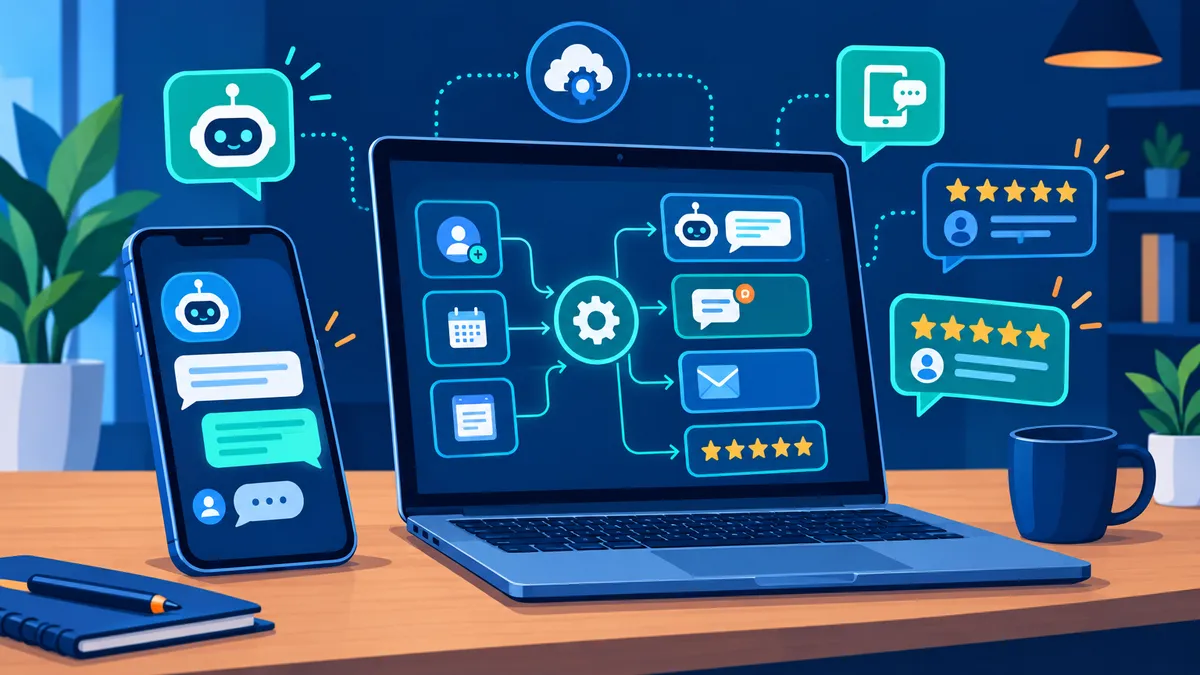
Why Small Business Marketing Automation Is No Longer Optional in 2026
Why Small Business Marketing Automation Is No Longer Optional in 2026
If you're still manually following up on every lead, chasing reviews after each job, and sending marketing messages one by one — you're working harder than you need to. And more importantly, you're falling behind.
In 2026, marketing automation has moved from a "nice-to-have" to a fundamental requirement for any small business that wants to compete, convert, and grow. The market for automation software is projected to reach $8.14 billion this year — and the businesses driving that number aren't just enterprise giants. They're local service companies, contractors, retailers, and professionals just like your customers.
This post breaks down what's changed, what's working right now, and how a fully automated marketing system gives small businesses a serious edge in a crowded market.
The Problem Most Small Business Owners Don't Talk About
You didn't start your business to spend your days writing follow-up emails, asking clients for Google reviews, and manually posting on social media. But that's exactly where too many small business owners find themselves — buried in repetitive tasks that keep them reactive instead of strategic.
The average small business relies on a patchwork of disconnected tools, freelancers, and manual processes that deliver inconsistent results. In today's environment — where customers expect fast replies, personalized communication, and smooth digital experiences — that patchwork approach isn't sustainable.
The good news? The solution isn't hiring more people. It's building smarter systems.
What Marketing Automation Actually Does for a Small Business
At its core, marketing automation uses software and AI to handle repetitive marketing tasks automatically — triggered by customer actions, timing, or behavior. Instead of managing every touchpoint by hand, your system works for you around the clock.
Here's a snapshot of what a well-built automation system handles:
- Instant lead follow-up — the moment a prospect fills out a form or clicks your chat, they receive a personalized text and email automatically
- SMS and email drip campaigns — keeping your brand top-of-mind through consistent, multi-channel nurture sequences
- Review requests — automatically texting clients a 1-click review link the moment a project ends
- Missed call text-back — so no lead ever falls through the cracks just because you were busy
- AI voice and chat — handling inbound inquiries, qualifying leads, and booking appointments 24/7
- 1-click marketing campaigns — re-engaging past customers with exclusive offers and referral requests at the push of a button
The result: a pipeline that works even when you're not. Higher conversion rates, faster response times, and a business that doesn't stop growing just because you stepped away from your desk.
The 2026 Trends Every Small Business Owner Should Know
1. Speed-to-Lead Is Now a Competitive Advantage
The window between a prospect opting in and them contacting a competitor has never been shorter. The businesses winning new customers in 2026 are the ones who respond in seconds — not hours. Automated, personalized texts and emails that fire the instant a lead comes in aren't just impressive. They're expected.
A hands-free follow-up engine that engages prospects immediately and nurtures them through the pipeline — then pauses automation and alerts your team the moment a prospect replies — is the new standard for high-converting businesses.
2. AI-Driven Personalization at Scale
AI-driven personalization is one of the biggest forces reshaping small business marketing right now. Platforms can analyze customer behavior in real time and deliver tailored content at the right moment — sending targeted offers to repeat customers, customized service reminders, or seasonal promotions that feel individually crafted, not mass-blasted.
This isn't science fiction. It's happening inside well-built CRM and automation systems today, and it's accessible to businesses of any size.
3. Reputation Automation Is Table Stakes for Local SEO
Your Google reviews aren't just social proof — they're a direct local search ranking signal. Businesses that automate their review-collection process consistently outrank competitors in local search results, generating more leads with zero extra effort.
The right system automatically sends a 1-click review link the moment a job wraps up, and uses AI to reply to positive reviews with personalized, SEO-friendly responses. The result: higher rankings, unbreakable trust, and more inbound leads on autopilot.
4. Omnichannel Communication in One Unified Inbox
Customers reach out via text, email, social media DMs, phone calls, and web chat — sometimes all in the same week. Managing those conversations across separate apps creates gaps, delays, and dropped leads.
In 2026, top-performing small businesses operate from a single unified inbox that brings every channel — SMS, email, Facebook Messenger, Instagram DMs, Google Chat, and phone — into one place. Every conversation is captured. Nothing slips through.
5. Mobile-First, Always-On Marketing
With billions of global mobile users, every marketing touchpoint needs to be optimized for the phone first. That means mobile-friendly websites, SMS campaigns that land in the palm of your customer's hand, and automations that trigger based on real-time behavior — not a schedule someone set and forgot about.
Why a Done-For-You System Beats DIY Every Time
The challenge with most automation tools isn't the technology — it's the setup, integration, and ongoing management. Small business owners who try to build these systems themselves often end up with a half-finished CRM, a few disconnected automations, and more frustration than results.
That's the difference between software and a system.
A complete, done-for-you marketing system is fully set up, optimized, and managed from day one. Instead of struggling with multiple platforms, integrations, and marketing tools, you get everything you need to attract, convert, and retain customers — without the technical headaches.
The right partner handles strategy, design, and setup. You handle one click to launch.
What a Complete Small Business Automation System Looks Like
Here's what a fully activated marketing and CRM system should include in 2026:
- ✅ A conversion-focused website — engineered to turn visitors into text conversations, not just pageviews
- ✅ High-converting lead funnels — designed to guide prospects from interest to action
- ✅ Automated lead nurture campaigns — combining the 98% open rate of SMS with the educational power of email
- ✅ 5-star review automation — capturing glowing reviews and boosting local SEO on autopilot
- ✅ AI voice and chat — qualifying leads and booking appointments around the clock
- ✅ VOIP phone and unified inbox — managing every conversation from one centralized dashboard
- ✅ 1-click marketing campaigns — re-engaging past customers and generating referrals without extra effort
- ✅ Custom social media content — built to stop the scroll and drive real engagement
Frequently Asked Questions
Is marketing automation only for big businesses?
Not at all. In fact, automation levels the playing field — giving small businesses access to the same speed, personalization, and consistency that larger companies have relied on for years. Affordable, done-for-you systems make it possible for any local business to compete at the highest level without building an in-house marketing team.
What's the difference between a CRM and marketing automation?
A CRM (Customer Relationship Management system) organizes your contacts, tracks conversations, and manages your pipeline. Marketing automation is the engine that acts on that data — sending messages, triggering follow-ups, and nurturing leads automatically. The best systems combine both into one connected platform.
How quickly can I see results from automation?
Many businesses see an immediate improvement in lead response time and review volume within the first few weeks of going live. Longer-term improvements in local SEO rankings, conversion rates, and customer retention typically build over the first 60–90 days as the system collects data and the automations compound.
Do I need technical skills to use an automation system?
With the right done-for-you partner, no. The setup, integrations, and management are handled for you. You log in to a simple dashboard, respond to leads, and monitor your results — the complex work happens behind the scenes.
What does an automated lead follow-up look like?
The moment a prospect opts in — whether through a web form, ad, or chat — they receive an instant, personalized text and email. If they don't respond, the system continues a timed drip sequence across SMS and email. The moment they reply, automation pauses and your team gets an alert to step in and close the sale.
Ready to Stop Leaving Leads on the Table?
Marketing automation in 2026 isn't about replacing the human side of your business — it's about making sure the human side only shows up where it matters most: closing deals, delivering great work, and building real relationships.
Everything else? Let the system handle it.
At Bridge City Marketing, we build complete, done-for-you marketing and automation systems for small businesses — fully set up, optimized, and managed so you can focus on running your business, not chasing leads.
📞 Call us at 864-777-8144 or book a free demo today to see what a fully activated system looks like for your business.
