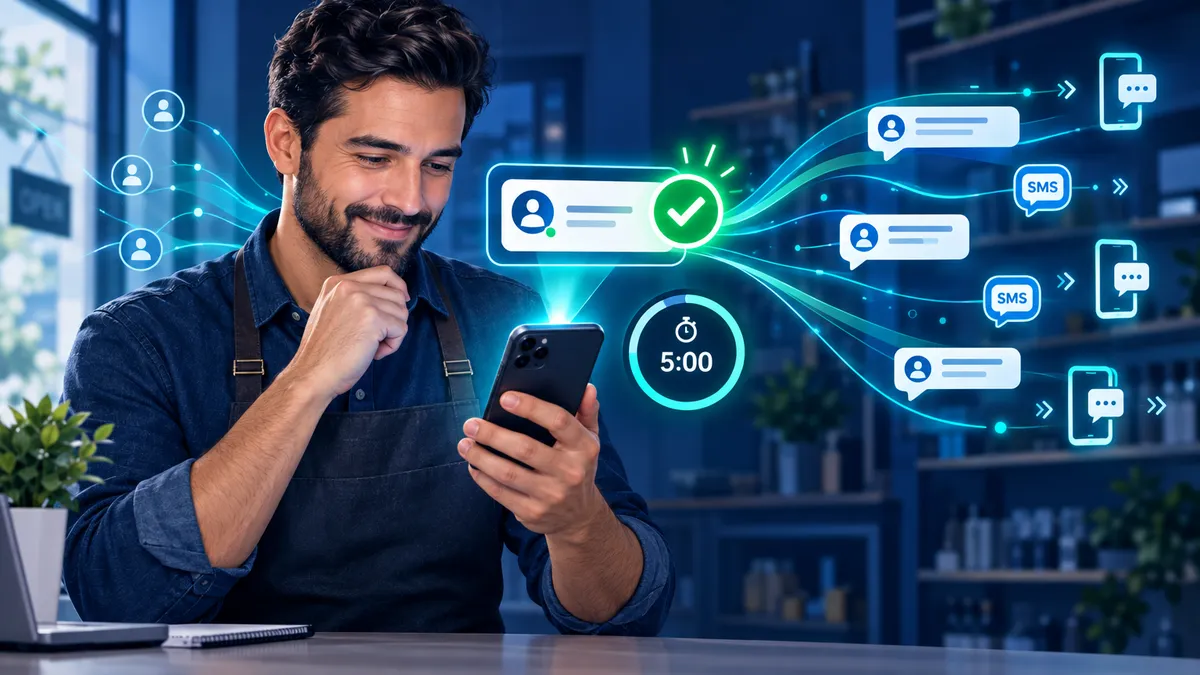
How AI Voice Agents Help Small Businesses Capture Leads 24/7 (And Why Yours Can't Afford to Wait)
How AI Voice Agents Help Small Businesses Capture Leads 24/7 (And Why Yours Can't Afford to Wait)
It's 9:47 on a Saturday night. A homeowner just had a pipe burst under the sink. They grab their phone, search for a local plumber, and call the first number they find — yours. It rings four times and goes to voicemail. They hang up and call the next result. By Sunday morning, that job is booked and done — just not by you.
This isn't a hypothetical. It's the everyday reality for thousands of small businesses across the country, and the numbers behind it are staggering. According to 2026 data from Blazeo, over 40% of high-intent inquiries arrive during evenings and weekends — exactly when most small business owners aren't available to answer. And among businesses that respond slowly during those hours, 77.3% report losing leads as a direct result.
The good news? AI voice agents have fundamentally changed what's possible — and small businesses that deploy them are capturing revenue their competitors are literally letting ring to voicemail.
The After-Hours Lead Problem Is Bigger Than You Think
Most small business owners know that speed matters when responding to new leads. But there's a dimension of this problem that often goes unaddressed: the sheer volume of leads that arrive when no one is around to answer them.
Industry benchmarks show that 38–62% of inbound leads arrive outside of normal business hours. If your follow-up process depends entirely on a human being available to pick up the phone or check a form submission inbox, you are structurally unable to compete for the majority of your own leads.
And the penalty for slowness is severe. Research consistently shows that responding within 5 minutes makes a business 100 times more likely to make contact compared to waiting 30 minutes. Worse, the average business still takes nearly 47 hours to respond to a new lead. That's not a small gap — that's a canyon between where most businesses operate and where they need to be.
The practical implication is clear: if you're relying on manual, business-hours-only response, your most motivated prospects are being funneled directly to your competitors.
What an AI Voice Agent Actually Does
AI voice agents are not the robotic phone trees of the past. Modern AI voice technology is conversational, responsive, and surprisingly human-feeling. Here's what a well-configured AI voice agent can do for your business around the clock:
1. Answer Every Call, Every Time
No matter when a prospect calls — midnight, a holiday, or during your busiest work hour on the job — the AI voice agent answers immediately. There's no voicemail, no hold music, no missed opportunity. The caller is greeted professionally and guided through a natural conversation.
2. Qualify Leads in Real Time
Rather than simply taking a message, AI voice agents can ask the right questions to qualify a caller before any human involvement. What service do they need? What's their timeline? Where are they located? Are they ready to book now? This information gets captured and organized automatically, so when your team follows up, they're calling a warm, pre-qualified lead — not starting from scratch.
3. Book Appointments Directly
The fastest path from an interested prospect to a confirmed customer is removing every possible friction point. AI voice agents integrated with your calendar system can book appointments on the spot — while the caller is still on the phone. Research supports this: letting prospects book a meeting immediately after an inquiry roughly doubles inbound conversion rates, jumping from around 30% to 67%.
4. Trigger Instant Follow-Up Sequences
After the call, the AI system doesn't just file the information away. It can automatically trigger a personalized follow-up text and email — keeping the conversation alive, delivering your business information, and providing a direct link to book or get a quote. For leads that don't pick up when you call back, this automated sequence keeps you in front of them without any manual effort.
The Missed Call: Your Most Expensive Habit
There's one scenario that deserves its own spotlight: the missed call.
For service businesses — HVAC companies, plumbers, roofers, salons, dental offices — the phone is still the primary inbound channel. And every missed call is a lead that just walked to your competitor's door. For a service business generating $500,000 annually, even a 10% revenue leakage rate from missed and delayed responses translates to $50,000 left on the table every year. Factor in the lifetime value of a customer — repeat business, referrals, annual service contracts — and that number grows considerably larger.
A missed call text-back system is one of the highest-ROI moves a small business can make. The moment a call goes unanswered, an automated SMS fires off to the caller — opening a real, two-way text conversation before they've even put their phone down. It's not a generic "sorry we missed you" message. It's a personalized touchpoint that says: we saw you called, we care, here's how we can help right now.
AI Handles the Speed Problem — Humans Handle the Relationship
One of the concerns small business owners raise about AI voice technology is the fear that it will feel impersonal or damage the customer relationship they've worked hard to build. This is a legitimate concern — but it misunderstands how effective AI deployment actually works.
The goal of AI voice agents is not to replace human connection. It's to eliminate the gap between "I'm interested" and "someone acknowledged me." That gap — often measured in hours or days with manual processes — is exactly where leads go cold and customers choose competitors.
Current data from Salesforce shows that while 73% of consumers have interacted with AI chatbots or voice tools when contacting businesses, 61% still prefer human follow-up once the initial contact is made. The winning formula in 2026 is AI for instant acknowledgment and qualification, and humans for the relationship-building and close.
When your AI answers at 10 PM, qualifies the caller, books a consultation, and sends a personalized follow-up text — all before you wake up the next morning — you're not replacing the human experience. You're making sure the prospect is still there for it.
What This Looks Like for a Real Small Business
Picture a residential HVAC company in a mid-sized market. They run Google ads, have a solid website, and a good reputation. But their team works 8 AM to 5 PM, and their after-hours calls go to a generic voicemail. On average, they return calls the next morning.
Here's what changes when they deploy an AI voice agent:
- A homeowner calls at 7:30 PM with a broken AC unit in July. The AI answers immediately, captures their address, confirms it's an urgent situation, and books an emergency service visit for the next morning — offering two time slots pulled directly from the tech's calendar.
- An automated follow-up text fires within 60 seconds, confirming the booking, sharing the technician's name, and providing a link to the company's reviews so the customer feels confident about their choice.
- The owner wakes up to a booked appointment, a qualified lead summary, and a happy customer — all without lifting a finger.
That same lead, 90 days earlier, went to voicemail and booked with the competitor across town by morning.
How to Know If You Have a Lead Response Gap
Before you can close the gap, you need to know it exists. Here are the key questions to ask about your current lead response infrastructure:
- What happens when someone calls after 5 PM or on a weekend?
- How long does it take your team to respond to a web form submission?
- Do leads from social media DMs get acknowledged the same day?
- If a prospect doesn't respond to your first follow-up, does anyone reach out again — automatically?
- Can a prospect book an appointment with you without talking to a person first?
If the honest answer to any of these is "not well" or "I'm not sure," you have a lead response gap — and it's costing you money every week.
The Unified Inbox Advantage
AI voice agents are most powerful when they're part of a connected system. One of the most common failure points for small businesses is that leads arrive through five or six different channels — phone calls, web forms, Instagram DMs, Facebook messages, email, and text — and land in completely separate places. When your team has to manually check each platform, things get missed. Leads go cold. Revenue evaporates.
The solution is a unified inbox: a single place where every inbound conversation — regardless of channel — flows automatically. When your AI handles the first touch and every subsequent message appears in one organized feed, your team can prioritize, respond, and close without the chaos of platform-hopping.
This is the infrastructure that separates businesses that grow predictably from those that always feel like they're playing catch-up.
Frequently Asked Questions
Will an AI voice agent sound robotic to my customers?
Modern AI voice technology has advanced dramatically. Today's AI agents use natural language processing that makes conversations feel fluid and professional. Most callers interact comfortably with them, especially when the AI quickly provides the help they're looking for — like booking an appointment or answering a basic service question.
Do I need technical experience to set up an AI voice agent?
With a done-for-you system, no. The right marketing partner handles the setup, configuration, call flows, and integration with your calendar and CRM entirely on your behalf. You review and approve — then it runs in the background automatically.
What happens when the AI can't answer a caller's question?
Well-designed AI voice systems are built with escalation paths. If a caller's question is outside the AI's scope, it can take a message, flag the call for a callback, or transfer to a live team member if one is available — ensuring no caller feels abandoned.
How quickly can this be up and running for my business?
With the right partner, a complete AI voice and follow-up system can be live in a matter of days — not months. The key is working with a team that specializes in activating these tools for small businesses, rather than handing you software and leaving you to figure it out.
Is this only useful for businesses that get a lot of calls?
Not at all. Even a business receiving 20–30 inbound calls per week can see significant revenue impact from capturing even a handful of after-hours leads that would otherwise be lost. The ROI of AI voice automation tends to be immediate and measurable.
Stop Losing Leads While You Sleep
The businesses winning in today's market aren't necessarily the ones with the best product or the flashiest ads. They're the ones that respond first, follow up consistently, and never let a motivated prospect fall through the cracks — whether it's Tuesday at noon or Saturday at midnight.
AI voice agents, combined with automated follow-up sequences, a unified inbox, and missed call text-back, create a lead capture system that works around the clock — without adding headcount or burning out your team.
At Bridge City Marketing, we build these systems for small businesses from the ground up. Everything is set up, activated, and managed for you — so you can focus on doing the work while your marketing works on autopilot.
Ready to stop missing leads after hours? Book a free demo and see how our AI Voice & Conversations system can start capturing leads for your business — 24/7, starting this week.
